
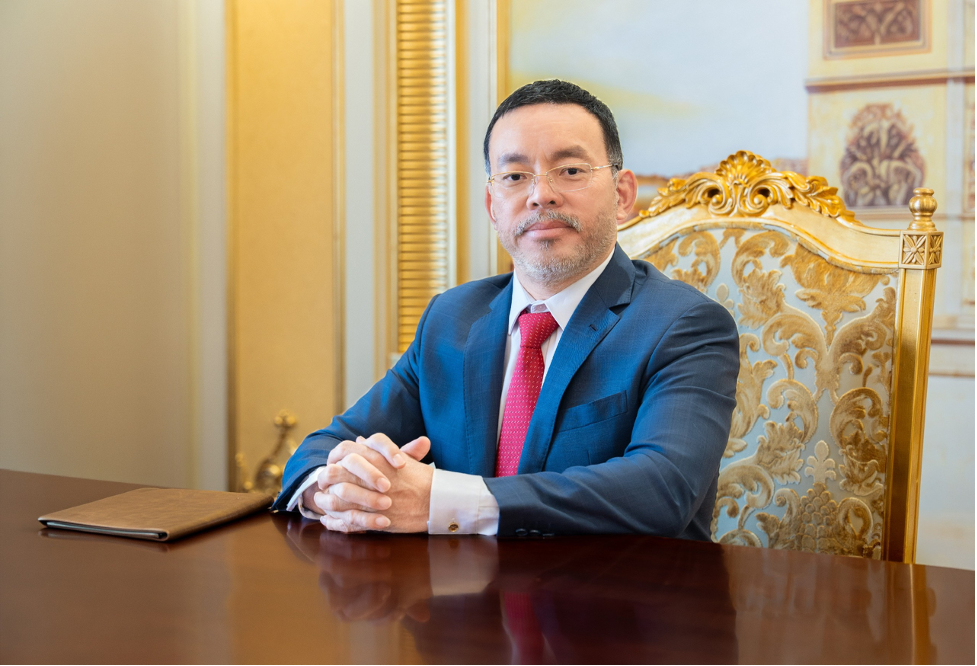
Mr. Luong Tri Thin, Founder and Chairman of the Strategic Council of BLUEMARQ GROUP, tells VET why Dat Xanh is restructuring into BLUEMARQ GROUP and why Vietnam’s next growth phase demands a new real estate model built on long-term investment and asset management.
Why
did you decide this was the time for Dat Xanh to move to a completely different
model?
Dat
Xanh has had nearly 23 years of very successful development, but having gone
through many ups and downs in the market, I see very clearly that the old model
will eventually hit its development ceiling. If we continue to follow the old
model, we will be limited by our own success.
Many
people think businesses only change when they encounter difficulties. I think
the opposite. Every successful organization, if it wants to go further, will
have times when it must bravely change. And that change must come before the
market forces the business to act; it is too late to change when the pressure
appears.
Dat
Xanh has repeatedly been ahead of market trends; with BLUEMARQ GROUP, we will
do the same.
A
major motivation for this transformation is the change in the nation’s
development strategy. Vietnam aims to become a developed country with high
income by 2045. A new era for the nation is opening up, with the private
business sector identified as an important driver of the national economy.
When
the country needs it, large private enterprises must be leading forces, bold
enough to step forward, dare to take on greater responsibilities, dare to
innovate business models, and find new directions to create greater value for
the economy, driving national development.
What
do you see as the biggest limitation of the traditional real estate model?
The
biggest limitation is that growth depends entirely on the cycle. When the
market is favorable, everything moves very quickly. When the cycle reverses,
pressure on cash flow, capital, and operations appears almost immediately.
Businesses that rely solely on that model will find it very difficult to go the
distance. You can’t build a billion-dollar corporation
solely through real estate sales launches.
A
deeper limitation lies in how the capital market and investment funds view the
business. A traditional developer is valued by the number of products sold in
each quarter. But an investment, asset management, and global real estate
development group, the model
BLUEMARQ GROUP is aiming for, will
be valued more highly for its portfolio of operating assets, the quality of its
cash flow, and its ability to weather many ups and downs in the market. These
two valuation methods not only yield different numbers. They determine the
position of the business, including what kind of capital it can access, from
whom, and under what conditions.
Vietnamese
real estate businesses have long been accustomed to selling assets but are not
yet accustomed to operating them. BLUEMARQ GROUP is built to change that.
Globally,
CapitaLand Investment, Brookfield, Blackstone, and ESR Group have been
following this direction for many years. Vietnam will certainly move in that
direction as well. If Vietnamese businesses are not proactive, the major assets
of the economy will end up in the hands of foreign businesses. I do not want
that to happen.
What
is the core difference between the mindset of simply developing projects and
the mindset of investing, managing assets, and developing real estate?
I
often use a very simple example. Consider an office building in the city
center. A simple developer will look at it and ask how much we can sell it for
and how long it will take to recover the capital. But an investment, asset
management, and real estate development organization will ask how much cash
flow and operational value this building can generate over the next 10 or 20
years.
With
BLUEMARQ GROUP, real estate development remains a core competency. But we do
not stop there. We are changing the way we view assets, how we use capital, and
our growth methods to enter larger playing fields, expanding cooperation with
financial institutions and international investors.
More
importantly, we want BLUEMARQ GROUP to represent a generation of Vietnamese
private enterprises capable of long-term cooperation with them, not just
developers looking for capital for individual projects.
What
makes you believe this is the right time to undertake this comprehensive
restructuring?
I
believe that the next phase of the Vietnamese real estate market will be a
completely different game, where businesses compete not only on the speed of
project development but also on management capacity, the ability to control
capital flow, the level of transparency, and organizational resilience.
More
importantly, I see that this moment in Vietnam presents very different
opportunities than before: a complete and strict legal framework for the market
to develop more sustainably. International capital is also changing its
approach to Vietnam, no longer just looking for individual projects to invest
in but seeking domestic partners with the capacity to accompany them for the
long term. Major initiatives such as establishing the International Financial
Center in Ho Chi Minh City and Da Nang also present significant opportunities.
In
particular, the government is launching the GoGlobal strategy,
encouraging Vietnamese businesses to enter international markets and
participate more deeply in the global value chain.
We
have been thinking about reaching a new operating model for many years, not
just recently. Now, the business is large enough, the opportunity has come, and
the country needs it, so we must move forward
decisively.
According
to you, what is the biggest challenge in the restructuring from Dat Xanh to
BLUEMARQ GROUP this time?
The
biggest challenge is breaking the inertia of our own success. Any organization,
after many years of success, will develop an operating method that becomes
deeply ingrained in the system.
Dat
Xanh is no exception. The processes, decision-making methods, and ways of
measuring efficiency were all built to serve the project development and sales
model. That model once helped Dat Xanh grow very quickly. And precisely because
it was so effective, change will not be easy.
It
will be very challenging, but I and the leadership team at BLUEMARQ GROUP are
determined to pursue this restructuring strategy to the end. In a large
organization, when leaders truly change, the operating system, decision-making
methods, and ways of measuring efficiency will gradually be forced to change as
well. Then a new inertia will form, and the entire organization will begin to
transform accordingly.
What
benefits will BLUEMARQ GROUP’s model after restructuring bring to shareholders,
customers, and investors?
This
model will create more sustainable benefits for shareholders, customers, and
partners accompanying BLUEMARQ GROUP.
For
shareholders, the value of the business will no longer depend entirely on each
short-term sales cycle but will instead be built on the ability to operate,
manage assets, and maintain organizational resilience over the long term.
For
customers, we do not sell products; we sell experiences and real value. We are
responsible for the quality of assets, the quality of service, and the
long-term use value of projects for many years to come.
But
in my opinion, the vision of a large enterprise cannot stop at profits or
growth for itself alone. That is important, but not ambitious enough.
BLUEMARQ
GROUP is built to go beyond the story of a real estate business. We want to
contribute to forming a new generation of Vietnamese enterprises capable of
creating and managing large assets for the economy, with the stature to become
strategic partners of the world’s leading investment organizations.
We
are building BLUEMARQ GROUP into a global investment, asset management, and
real estate development group, capable of generating long-term, sustainable cash flow through a business model designed to endure across
generations without
depending on any individual. That is the real aspiration behind our decision to
restructure Dat Xanh into BLUEMARQ GROUP.
BLUEMARQ
GROUP officially launched on May 20, 2026, marking Dat Xanh’s most significant
transformation after nearly 23 years of development. From a real estate
developer, the company has begun a comprehensive restructuring to become a
global real estate investment, asset management, and development group.
Behind this
strategy is Mr. Luong Tri Thin, Founder and Chairman of the Strategic Council,
who has repeatedly positioned Dat Xanh at the forefront of market trends, from pioneering the “Apartment Supermarket” model in
2004 and driving digital transformation during the pandemic to now
restructuring the company’s entire operating model at its largest scale to
date.
–




0 Comments