

Introduction
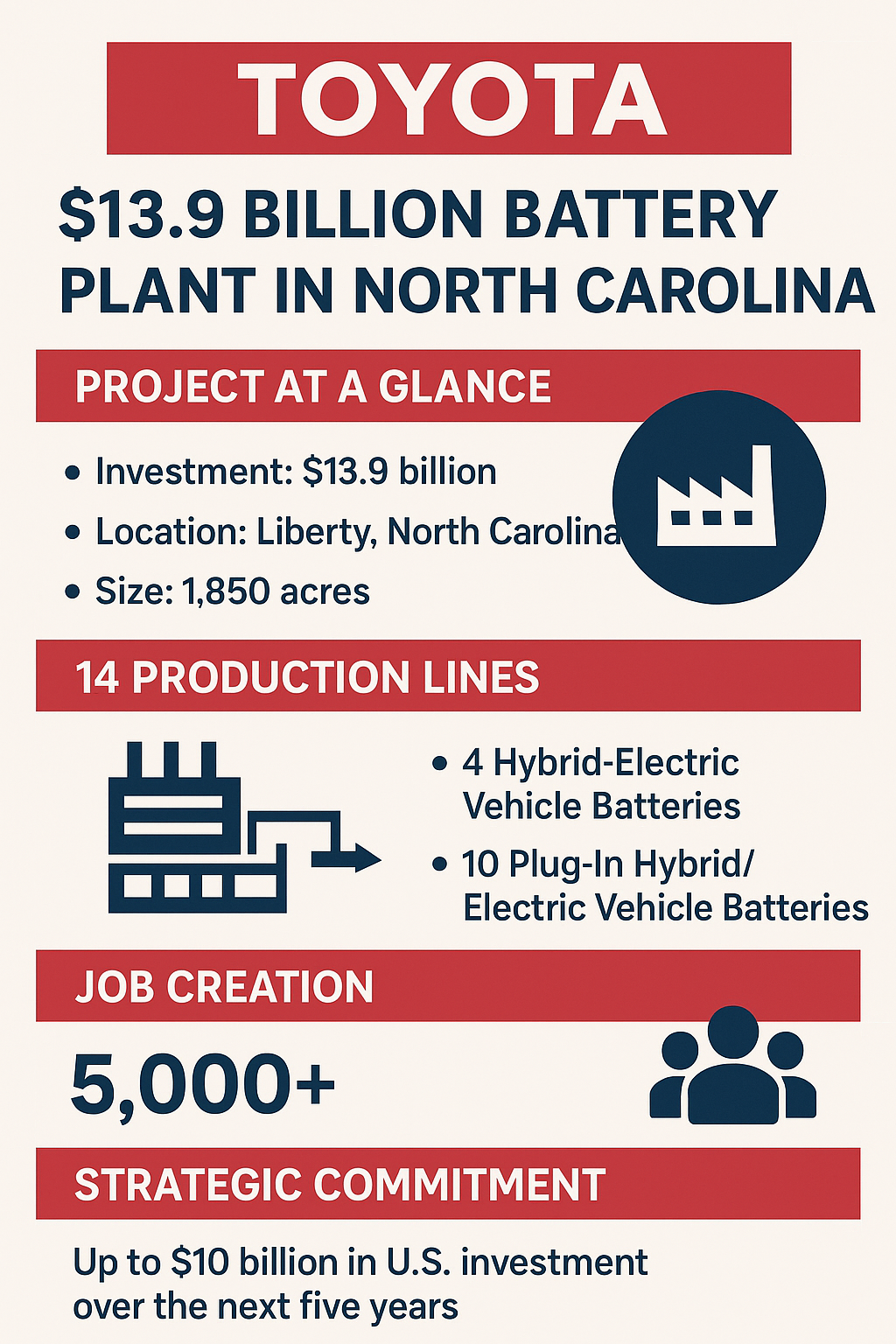
On November 12, 2025, Toyota Motor Corporation officially launched its $13.9 billion battery manufacturing plant in Liberty, North Carolina. The facility represents one of the largest investments in U.S. automotive manufacturing by a foreign automaker in recent years.
The plant strengthens Toyota’s U.S. supply chain, accelerates its hybrid and electric vehicle strategy, and supports economic growth in North Carolina, making it a significant development for the automotive industry, investors, and local communities alike.
Key Details About the Plant
Investment and Scale
-
Total investment: $13.9 billion, one of Toyota’s largest single investments in the United States.
-
Facility size: Approximately 1,850 acres near Greensboro/Liberty, North Carolina.
-
Production capacity: The plant will operate 14 production lines — 4 for hybrid-electric vehicle (HEV) batteries and 10 for plug-in hybrids (PHEV) and EV batteries.
-
Annual battery output: Expected to reach around 30 GWh when fully operational.
Employment and Economic Impact
-
Jobs created: Over 5,000 high-tech positions directly at the plant.
-
Local ecosystem: Supporting suppliers, logistics companies, and workforce training programs.
-
Economic boost: Increased state and regional economic activity, attracting further foreign and domestic investment.
Toyota’s Broader U.S. Investment Strategy
Alongside the battery plant, Toyota confirmed plans to invest up to $10 billion in U.S. manufacturing over the next five years. This strategy signals a commitment to strengthening domestic production capabilities amid global supply chain uncertainties.
Strategic Importance of the North Carolina Battery Plant
Strengthening Domestic Manufacturing
Battery production is a critical component of EV and hybrid technology. By manufacturing batteries domestically, Toyota reduces dependency on overseas suppliers and mitigates geopolitical risks. The plant positions the U.S. as a growing hub for advanced battery technology.
Supporting Hybrid and EV Growth
While the EV market experiences rapid expansion, Toyota continues to prioritize hybrid vehicles while simultaneously scaling EV production. The Liberty plant will supply batteries for both hybrids and plug-in EVs, ensuring Toyota can respond flexibly to evolving market demands.
Regional and Community Benefits
-
High-value job creation for engineers, technicians, and plant workers.
-
Partnerships with local educational institutions for workforce training.
-
Development of North Carolina as a center for advanced automotive manufacturing.
Market Implications
For Toyota
-
Strengthens Toyota’s North American manufacturing footprint.
-
Provides a strategic advantage in battery technology, which is critical for long-term EV competitiveness.
For Suppliers
-
Boosts demand for raw materials like lithium, nickel, and cobalt.
-
Expands opportunities for local and regional component suppliers.
For Consumers
-
Potential for cost stabilization in hybrid and EV vehicles due to domestic production.
-
Faster deployment of hybrid and EV models in the U.S. market.
For the Industry
-
Signals that U.S. battery production is no longer limited to West Coast facilities or foreign markets.
-
Encourages competitors to increase domestic investments in EV supply chains.
Challenges Ahead
Production Ramp-Up
-
Recruiting and training a skilled workforce.
-
Ensuring quality control and production efficiency at scale.
Market Uncertainty
-
EV market adoption remains uneven; Toyota’s hybrid strategy acts as a hedge.
-
Consumer incentives and regulatory shifts could affect demand for plug-in EVs.
Raw Material Sourcing
-
Batteries rely on materials like lithium and cobalt.
-
Ethical sourcing and sustainable production practices will be closely scrutinized.
Infrastructure and Community Integration
-
Local infrastructure must support plant operations, including roads, utilities, and housing for employees.
-
Partnerships with educational institutions and vocational programs are critical for long-term workforce development.
Environmental and Sustainability Impact
Toyota emphasizes sustainable production and environmental responsibility. The plant will feature:
-
Energy-efficient battery production lines.
-
Waste reduction initiatives in manufacturing.
-
Partnerships with local and global suppliers to ensure responsible sourcing of materials.
By focusing on sustainability, Toyota aims to strengthen its environmental reputation while meeting the growing regulatory requirements in the U.S. and globally.
Conclusion
The launch of Toyota’s $13.9 billion battery plant in North Carolina represents a significant milestone in U.S. automotive manufacturing, hybrid and EV technology, and regional economic development. With its focus on domestic production, hybrid and EV battery supply, and community investment, the Liberty plant exemplifies the future of advanced automotive manufacturing in the United States.
This investment positions Toyota to remain a leading player in the evolving automotive landscape while creating tangible benefits for local communities, the workforce, and the broader EV ecosystem.
Source: CNBC




0 Comments