Vietnam Economic Times / VnEconomy sought the perspectives of industry stakeholders on the recent upgrade of Vietnam’s stock market in terms of market reforms, capital inflows, and long-term growth prospects.
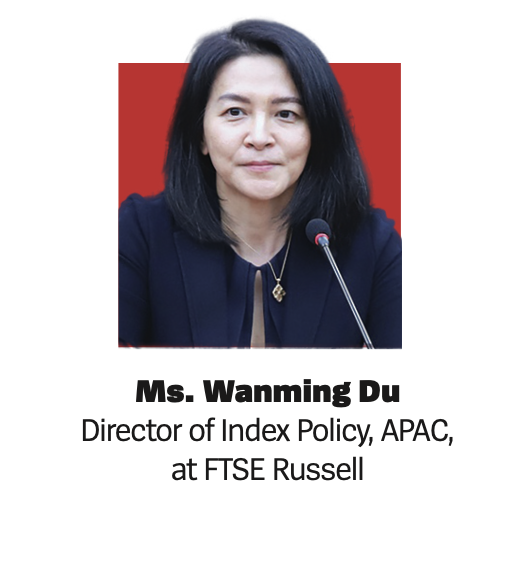
Ms. Wanming Du, Director of Index Policy, APAC, at FTSE
Russell
Over the past two years, FTSE Russell has worked closely with Vietnamese
regulators and witnessed many reforms aligned with international standards,
such as non-pre-funding trading and improved failed-trade handling procedures.
We also recognize Vietnam’s detailed roadmap for future developments, including
the implementation of a Central Counterparty Clearing mechanism by 2027 and the
streamlining of account-opening processes to facilitate foreign investor
participation.
Vietnam will be included in index groups with a combined asset scale of
hundreds of billions of US dollars. We estimate that the country could attract
an additional inflow of about $1-1.5 billion in passive funds and around $4-5
billion in active funds, totaling some $5-6 billion in new capital into the
market.
The upgrade process will be carried out in several stages from now until
September next year, with the specific number of steps to be decided in March.
That will also be when we update our models on how Vietnam enables global
brokers to access the domestic market.
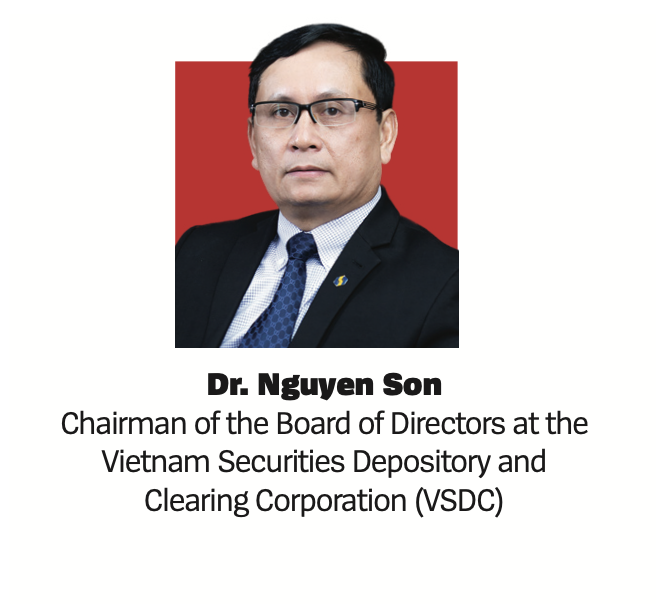
Dr. Nguyen Son, Chairman of the Board of Directors at the
Vietnam Securities Depository and Clearing Corporation (VSDC)
To meet the growing demand from international investors
and support Vietnam’s stock market upgrade, VSDC is accelerating the
modernization of its technological infrastructure to operate on globally-recognized
platforms. Such efforts are not merely technical, they also lay the foundation
for Vietnam’s capital market to achieve sustainable growth and deeper
integration.
VSDC was assigned several key tasks in a recent decision from
the Ministry of Finance (MoF). One of the most important is to develop a
Straight Through Processing (STP) platform for real-time interaction between
custodian banks and securities companies. Since Vietnam allowed foreign
investors to trade without 100 per cent pre-funding, the need for automated
connections between custodian banks and brokers has become urgent, replacing
the current manual communication process.
We are building this interactive platform to enable
global custodian banks and domestic securities firms to connect directly and
automatically. This is a large-scale technology project requiring close
cooperation between securities firms and, in particular, global custodians.
Under an MoF directive, the project must be completed in
time for FTSE Russell’s review in March 2026, targeting Vietnam’s official
market upgrade on September 21, 2026. Technology providers have indicated that
even under the fastest scenario, completion could take until December 2026,
creating significant pressure that requires careful planning and strong support
from global custodians.
The MoF decision also assigns the VSDC to develop an
investment fund information platform to modernize and increase transparency in the
country’s fund management industry. VSDC plans to roll out this platform in
2026, including a system for evaluating fund performance over multiple years
and recognizing top performers.
Another foundational task is the establishment of a
Central Counterparty Clearing (CCP) mechanism. Without a CCP, any transaction
failure due to insufficient cash or securities could damage market credibility, especially among
foreign investors. A CCP would ensure settlement safety and enhance
transparency and stability. VSDC has committed to regulators to implement a CCP
roadmap, with Phase 1 (“go-live”) expected in early 2027. It is currently
finalizing its proposal to the MoF before formally establishing this new legal
entity.
Furthermore, once the KRX trading platform operates
stably and the market continues to grow, we will need to expand system
capacity, upgrade servers, and integrate features allowed under the investment
package, such as short selling, same-day trading, and selling pending
securities. The CCP will also be incorporated into this framework, with gradual
rollouts based on risk management capacity.
In line with the directives from the government, the MoF,
and the State Securities Commission, we will also gradually introduce new
products, such as VN100 futures contracts, index options, and other innovative
products from HoSE. We will design these systems in parallel – from
registration, depository, and clearing processes to connections with payment
banks.
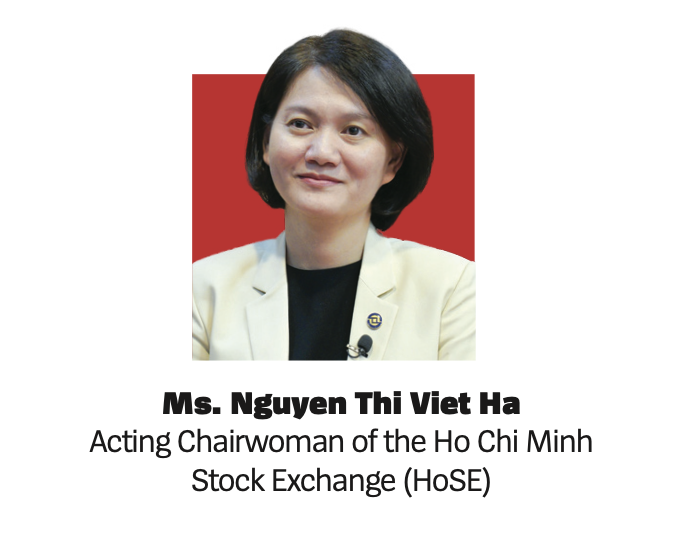
Ms. Nguyen Thi Viet Ha, Acting Chairwoman of the Ho
Chi Minh Stock Exchange (HoSE)
With double-digit targets for economic growth in the
coming years, the potential inflows of domestic and foreign capital into the
market are quite large. Even just $15 billion of domestic capital would be
substantial. This primarily requires that our technological infrastructure be
capable of handling such demand.
We now have a new system that meets market requirements,
but given the market’s pace of growth, HoSE must urgently continue upgrading
its IT systems. We also need to improve the quality of listed products. HoSE is
constantly striving to innovate and enhance the quality of market offerings,
for example promoting ESG [environmental, social, and governance] and
sustainable development practices among listed companies. The goal is to bring
more high-quality products to the market to meet the needs of both domestic and
foreign investors. These are the two major directions for HoSE in the time to
come.
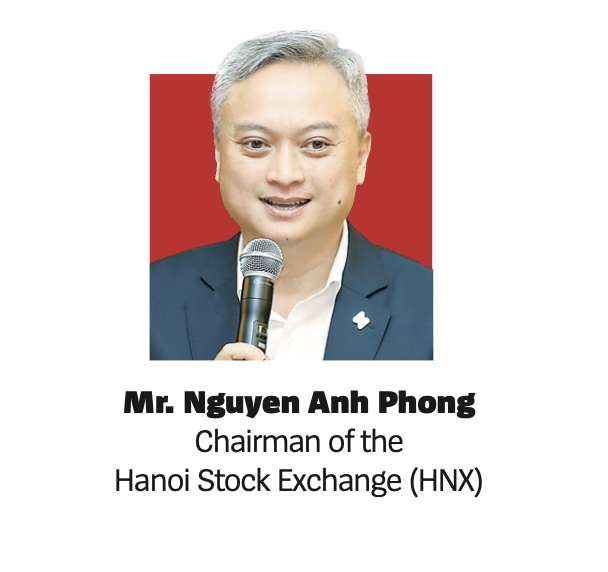
Mr. Nguyen Anh Phong, Chairman of the Hanoi Stock
Exchange (HNX)
It is necessary to strengthen support for companies in
disclosing information and complying with market regulations. In particular, we
must improve English-language disclosure, almost simultaneously with
Vietnamese. This will allow foreign investors to access information
immediately, contributing to a more open and transparent market.
Beyond promoting both the quantity and quality of the
stock market, the bond market also presents challenges and opportunities in the
new context and growth space. Government bonds are an important segment as we
develop, addressing public debt issues and boosting public investment. HNX is
working with the State Treasury to build technological infrastructure to
develop the bond market, helping the government mobilize additional resources
for economic development. It also plans to improve the yield curve to better
reflect market conditions, providing members and investors with a reliable
reference.
Regarding the derivatives market, HNX recently launched
VN100 futures contracts, a new product offering investors additional options
for risk hedging, efficient capital use, and a safe haven during volatile
periods. In the coming period, it will continue researching and reporting to
the State Securities Commission on introducing index options within 1-2 years,
following the development strategy of starting with simple derivatives before
gradually introducing more complex products to attract both domestic and
international investors.
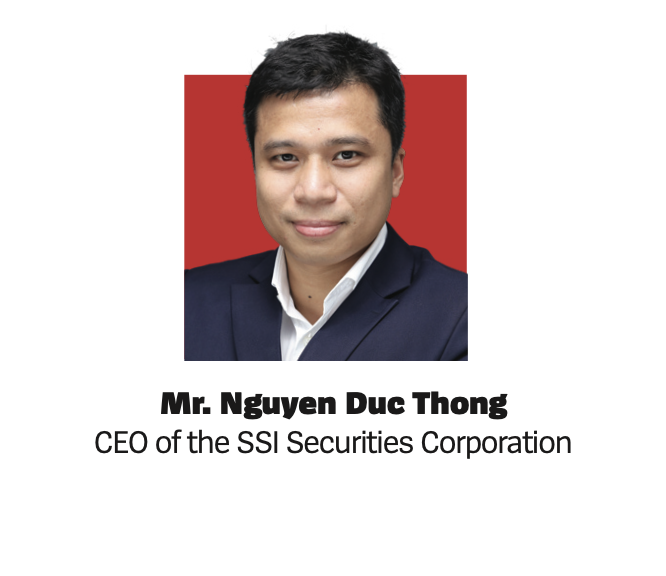
Mr. Nguyen Duc Thong, CEO of the SSI Securities
Corporation
Essentially, the supply side of the stock market is still
limited. However, we greatly appreciate the efforts of regulators, who have
been implementing multiple measures to timely increase market supply.
Regarding solutions to boost supply, in my view, the
State Securities Commission should create mechanisms to relax listing criteria
for tech companies. Looking at other markets like China and the US, if tech
companies were always required to be profitable for two years, there would have
been no Apple, Alibaba, or Tencent. Startups need capital most when they are
just starting. Therefore, lowering the listing criteria for tech companies would
help them resolve funding challenges and gain access to market capital. This is
crucial for developing the stock market.
Another point is that we hope regulators will explore and
develop more derivatives products to give investors access to new instruments,
manage risks, and stimulate demand in the underlying market through
derivatives.
Vietnamese investors can come in two clear extremes:
those seeking high risk invest in stocks, while those seeking safety use
savings. But there is a large middle segment of investors who want moderate
safety while accepting some risk. Other Asian markets, such as China, South Korea,
and Thailand, and those in Europe offer a variety of prominent products that
allow investors to invest with confidence while earning returns.
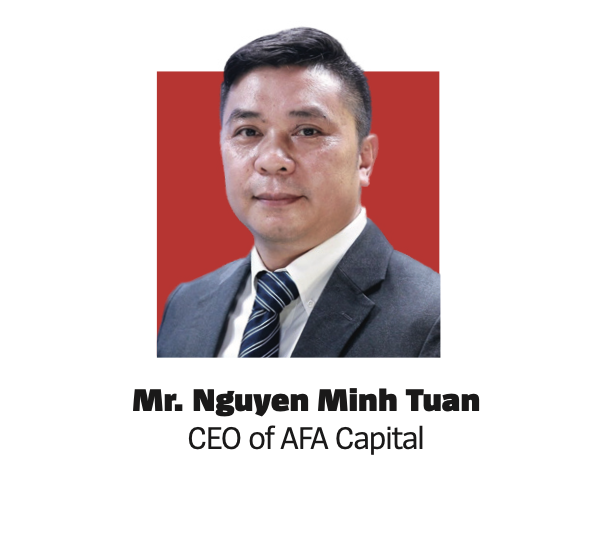
Mr. Nguyen Minh Tuan, CEO of AFA Capital
A large amount of capital will be needed in the next
five-year cycle, with GDP growth targets in the double digits. Our monetary
policy will certainly need to remain in a loosening cycle to support economic
growth. Capital inflows will come largely from domestic sources, and after the
market upgrade, foreign investment will add another layer of inflows. However,
in terms of supply, our IPO rate is the lowest in Southeast Asia.
My observation is that the stock market today is very
similar to the real estate market, with limited supply and primarily high-end
segments. On the stock market, most shares are in finance, banking, and real
estate, while core manufacturing and technology companies are largely absent.
Cyclical products lead to cyclical market development.
Therefore, solutions to address the current stock market
challenge focus on increasing the supply of products, including raising the
proportion of State-owned enterprise (SOE) equitization and increasing the
number of private companies listed. An important factor to accelerate SOE equitization
is to minimize valuation risks, which would allow for faster implementation.
For private companies, especially tech firms and
innovative startups, there could be a dedicated monitoring framework to provide
tailored policies supporting their IPOs. Of course, from an investor
perspective, criteria cannot be too low, otherwise investors could easily lose
money.
Regarding foreign capital, ownership limits are still in
place. It may be worth exploring new products, such as non-voting depository
receipts, for certain sectors where we want to retain control.
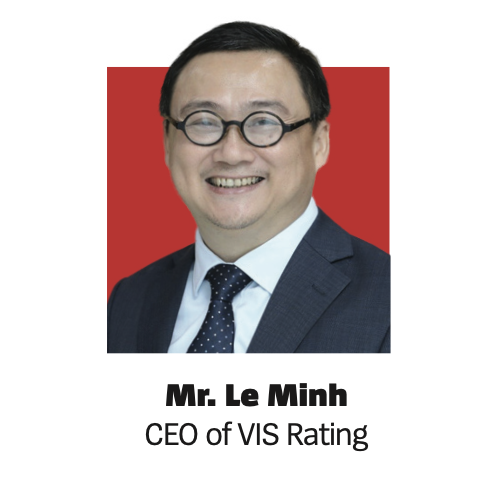
Mr. Le Minh, CEO of VIS Rating
When FTSE Russell approved Vietnam’s stock market
upgrade, its upgrade list also included Greece. The decision to upgrade Greece
was based on four factors, one of which clearly stated that a key consideration
was that its market is currently classified as investment-grade by the three
leading global rating agencies: Moody’s, Standard Poor’s, and Fitch
Ratings.
This sends a signal to Vietnam: if the government bond
market does not meet investment-grade classification then achieving the next
market upgrade will be rather difficult, though the goal remains for MSCI to
approve such an upgrade by 2030. A higher market rating would help achieve
higher long-term objectives.
Moreover, we believe corporate bonds will play an
increasingly important role in the coming years to meet investment capital
needs aimed at double-digit GDP growth. Corporate bonds are expected to boom
after 2027.
VIS Rating’s research shows that following the 2022
crisis, when many bonds defaulted on interest payments, the market took four
years to recover. Calculations indicate that the bond market will enter a new
phase by 2027. The State regulator has also established a new legal framework
that is more transparent and investor-protective, improving overall bond market
quality.
In this collective effort, credit rating agencies act as
an “extended arm” of regulators. Previously, the State Securities Commission
carried full responsibility for ensuring bond market quality. Now, the
“gatekeeping” role has expanded. Maintaining the quality of rating agencies
provides an additional layer of protection for both the market and the
regulators themselves.
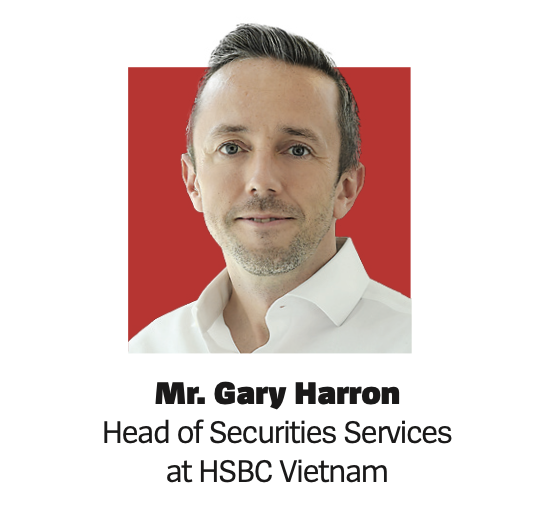
Mr. Gary Harron, Head of Securities Services at HSBC
Vietnam
We would like to congratulate Vietnam on this significant
milestone, with FTSE Russell confirming the long-awaited reclassification of
the stock market from Frontier to Secondary Emerging status. Effective
September 21, 2026, and subject to an interim review in March 2026, the upgrade
represents another example of how the country’s rising global profile can
withstand near-term challenges. The new status recognizes years of coordinated
efforts by the government, regulators, and market participants.
For Vietnam, shedding the Frontier label could profoundly
reshape investor behavior and confidence, altering the trajectory of its
long-term economic development and reducing dependence on any single trading
partner. HSBC Global Investment Research suggests that potential foreign
inflows could eventually range between $3.4 billion and $10.4 billion from
active and passive funds following the inclusion.
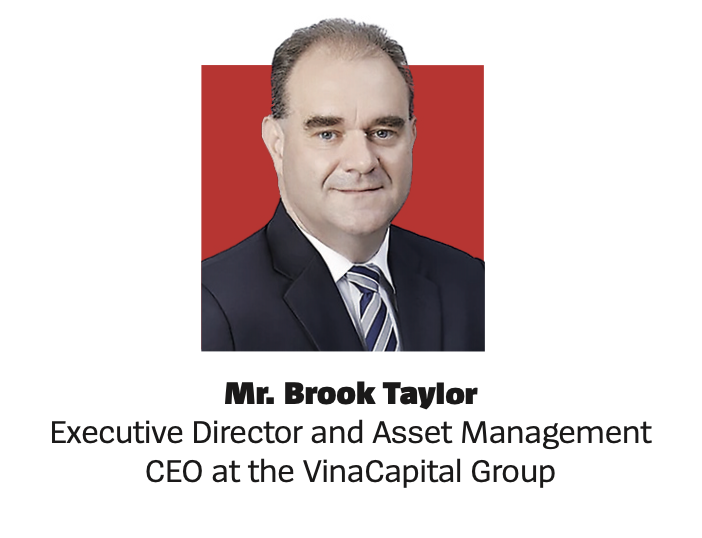
Mr. Brook Taylor, Executive Director and Asset
Management CEO at the VinaCapital Group
FTSE Russell’s upgrade to Emerging Market status could
attract around $5-$6 billion in investment into Vietnam. We believe that
inflows will not flood the market all at once, but having these investment
flows represents a meaningful and positive turning point for the market.
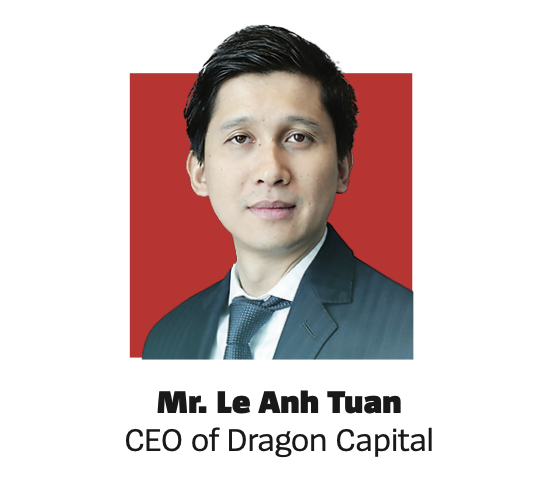
Mr. Le Anh Tuan, CEO of Dragon Capital
I see this as a very important step, because before
moving to the Emerging Market category, Vietnam was classified as a Frontier market.
Frontier markets are virtually ignored by investors. Therefore, joining the
Emerging Market category is vital. It is extremely important for Vietnam to
enter the global playing field.
VET-




0 Comments