
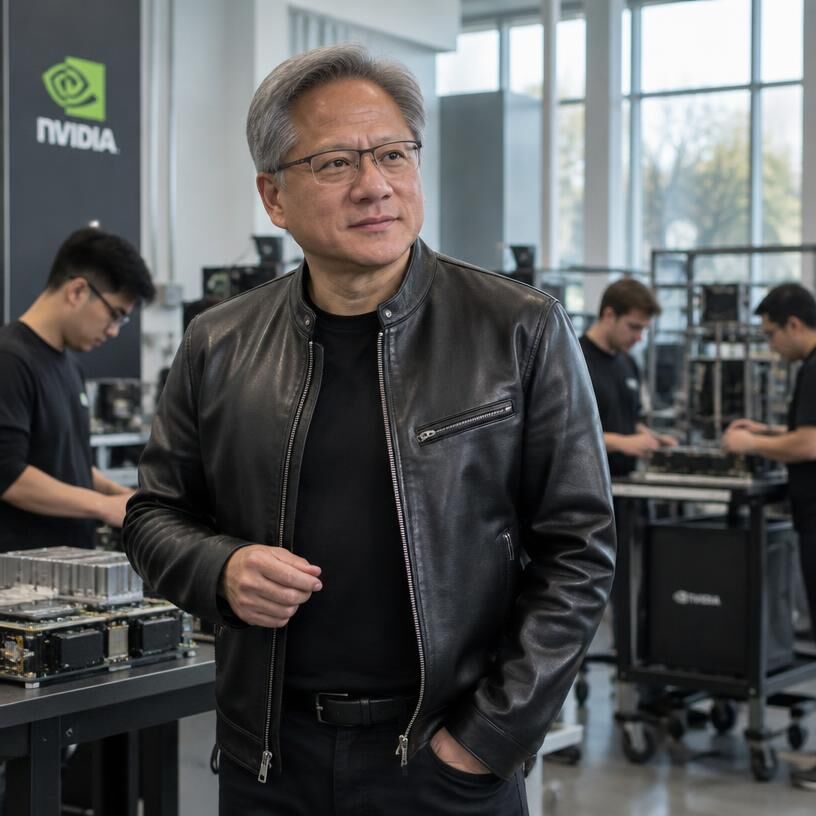
Donald Trump faces growing political scrutiny over his intervention to reinstate Nvidia CEO Jensen Huang, as concerns about AI, China, national security and corporate influence intensify in Washington.
Focus Keyphrase: Trump Jensen Huang Nvidia controversy
Secondary Keywords: Donald Trump AI policy, Jensen Huang Nvidia, Nvidia China chip exports, artificial intelligence regulation, US national security, Trump technology industry, AI political backlash.
Trump's Support for Jensen Huang Puts Washington Under Pressure
President Donald Trump's close relationship with Nvidia chief executive Jensen Huang is becoming an increasingly complicated political issue for the White House. What initially appeared to be a victory for the American artificial intelligence industry is now raising questions about political influence, corporate favoritism, national security and the economic consequences of the AI boom.
Trump's extraordinary intervention to help restore Huang to the leadership of Nvidia has attracted attention beyond Silicon Valley and Wall Street. Lawmakers from both political parties are increasingly interested in understanding why the president became personally involved in the company's leadership crisis and whether the administration's decisions concerning advanced semiconductor exports have adequately protected American national security.
The controversy comes at a particularly difficult moment for the Republican Party. Following disappointing midterm election results, Republicans face growing pressure to demonstrate that the administration is prioritizing ordinary Americans rather than wealthy technology executives and powerful corporate interests.
At the center of the debate is a fundamental question: Does America's AI strategy primarily benefit the national economy, or is Washington becoming too closely aligned with the interests of a small group of influential technology companies?
Why Trump Intervened to Support Nvidia's Jensen Huang
Nvidia occupies an extraordinary position in the global technology industry. Its advanced graphics processing units (GPUs) are essential components of modern artificial intelligence infrastructure, powering everything from large language models and cloud computing to autonomous systems and advanced scientific research.
Under Huang's leadership, Nvidia became one of the most strategically important companies in the global economy.
Consequently, uncertainty surrounding its executive leadership attracted considerable attention from investors, technology companies and policymakers.
The company's board initially removed Huang following revelations involving two extramarital relationships, including one with an individual suspected by US officials of having connections to Chinese intelligence. The allegations intensified concerns about corporate governance and potential national security vulnerabilities.
However, the situation changed dramatically when Trump pushed for Huang's reinstatement.
Nvidia subsequently brought Huang back as chief executive after an 11-day absence, creating an unusual intersection between presidential influence and private-sector corporate governance.
Trump publicly celebrated the outcome, presenting the decision as a positive development for American technological leadership.
For the administration, retaining an experienced executive at the helm of a strategically important American company could help preserve the country's competitive advantage against China.
Nevertheless, the president's involvement has created a political challenge that extends beyond Nvidia's corporate performance.
Congressional Investigations Could Increase Political Pressure
The controversy is moving toward Capitol Hill, where lawmakers are preparing to question Nvidia's leadership and examine the administration's relationship with the company.
Jensen Huang is scheduled to participate in congressional proceedings in December, including private interviews with House committees and a public appearance before the Senate Banking Committee on December 3.
These proceedings could examine several important issues:
-
Whether advanced Nvidia AI chips reached Chinese companies despite American export restrictions.
-
Whether existing semiconductor export controls adequately protect U.S. national security.
-
Why Trump personally encouraged Nvidia's board to reinstate Huang.
-
Whether government officials gave sufficient consideration to potential conflicts of interest.
-
How the administration balances American commercial competitiveness with restrictions on sensitive technology exports.
The political sensitivity is particularly significant because semiconductor technology has become a central component of American competition with China.
Washington has spent years attempting to restrict Beijing's access to advanced computing technology that could strengthen its artificial intelligence capabilities and military modernization.
If congressional investigations identify weaknesses in the enforcement of export restrictions, the administration could face pressure to introduce stricter controls.
The issue also creates an unusual political situation for Trump: some of the strongest questions about his intervention are coming from Republicans who have traditionally supported his economic and technology policies.
Nvidia, China and the National Security Debate
The relationship between Nvidia and China is one of the most complicated elements of the controversy.
China represents an important potential market for American semiconductor companies. However, Washington has increasingly treated advanced AI chips as strategically sensitive products rather than ordinary commercial goods.
The concern is that sophisticated computing technology could strengthen China's military capabilities, intelligence operations and domestic AI ecosystem.
American export controls are intended to limit access to certain advanced semiconductor products and related technologies.
However, enforcement is complicated by international supply chains, cloud computing services, intermediary companies and data centers operating outside mainland China.
Recent reporting has highlighted concerns that Chinese customers could potentially obtain access to restricted computing resources through overseas infrastructure.
The Trump administration has also moved to address loopholes involving remote access to advanced AI chips.
For Nvidia, these restrictions create a difficult commercial environment. The company must navigate government requirements while protecting its international business opportunities.
For Washington, the challenge is equally complicated: excessive restrictions could weaken American companies' commercial competitiveness, while insufficient controls could undermine national security.
Trump's support for Huang has therefore become part of a much larger debate about how the United States should manage its technological relationship with Beijing.
Political Connections and Questions About Corporate Influence
Another sensitive dimension concerns the financial relationships surrounding Nvidia and the Trump administration.
According to The Wall Street Journal, Trump held Nvidia stock that was valued at as much as $83 million at one point in October.
The company also committed $25 million toward Trump's White House ballroom project and contributed $1 million to his second inauguration.
These relationships have intensified questions about whether corporate interests and presidential decision-making are becoming too closely connected.
The White House has rejected suggestions that Trump personally directs investment decisions.
Spokesman Davis Ingle said the president's stock and bond investments are managed by independent financial institutions and that neither Trump nor his family can influence individual portfolio decisions.
Nevertheless, the political issue is not limited to whether a legal conflict of interest exists.
Public confidence in government institutions also depends on whether presidential decisions appear independent, transparent and consistent with the national interest.
When a president personally intervenes to support a powerful technology executive while his administration makes decisions affecting that executive's industry, questions about accountability are almost inevitable.
This creates a difficult communications challenge for the White House, particularly when voters are already concerned about the influence of wealthy corporations.
The Growing AI Backlash Among American Voters
Perhaps the most important political development is that public skepticism toward artificial intelligence is increasing.
Although technology executives frequently emphasize the economic benefits of AI, many Americans remain uncertain about how the transformation will affect their employment opportunities, household finances and local communities.
The concerns are understandable.
Businesses are increasingly exploring automation and AI-powered tools to reduce operating costs, improve productivity and reorganize their workforces.
For employees, however, these developments can create uncertainty about future employment opportunities, wages and the skills required to remain competitive.
The expansion of AI infrastructure is also generating controversy at the local level.
Large data centers require substantial electricity, land, cooling infrastructure and investment. Communities increasingly question whether the economic benefits justify the environmental and infrastructure costs.
According to polling cited by The Wall Street Journal, 57% of surveyed midterm voters believe artificial intelligence will do more harm than good for society, compared with approximately 25% who see more benefits than disadvantages.
The same survey found that three-quarters of respondents would oppose a new data center being constructed in their community.
These figures illustrate a significant challenge for politicians promoting aggressive AI investment.
Economic growth and technological leadership are important objectives, but voters also want to understand how these developments will improve their everyday lives.
Trump's administration has emphasized job creation, investment and industrial construction. However, the political benefits of these investments may be limited if Americans believe the biggest financial rewards are concentrated among technology executives and shareholders.
Why Republicans Could Face an Uncomfortable Political Debate
The Nvidia controversy arrives as Republicans attempt to rebuild their political position following the midterm elections.
The party must address several issues simultaneously, including the cost of living, employment, economic uncertainty and concerns about the administration's priorities.
The growing controversy surrounding AI provides Democrats with an opportunity to connect these economic concerns to broader questions about corporate influence and political accountability.
However, the issue is not necessarily limited to partisan politics.
Some conservative commentators have also warned that the administration could face difficulties defending its intervention.
The combination of presidential involvement, a wealthy technology executive, questions about China and public anxiety about AI could create a complicated political narrative.
Republicans may find themselves defending a technology industry whose economic benefits are not yet universally understood by voters.
At the same time, supporting stronger semiconductor restrictions could create tensions with businesses that argue American companies need access to international markets to maintain their global leadership.
This leaves Republican lawmakers balancing competing priorities: supporting Trump's economic agenda, protecting national security and responding to voter concerns.
What the Controversy Means for America's AI Industry
The political consequences could extend beyond Nvidia.
Artificial intelligence is increasingly viewed as a strategic industry comparable in importance to energy, telecommunications and advanced manufacturing.
Companies developing AI models, semiconductor equipment, data centers and cloud computing infrastructure depend on predictable government policies.
However, political controversy surrounding Nvidia could encourage lawmakers to demand stronger oversight of the entire AI ecosystem.
Potential developments include:
-
More rigorous enforcement of semiconductor export controls.
-
Greater congressional oversight of AI companies.
-
Additional transparency requirements for international chip distribution.
-
Stronger scrutiny of corporate relationships with government officials.
-
More debate about electricity consumption and data center construction.
-
New discussions about employment protections and the economic consequences of automation.
For technology investors, regulatory uncertainty could become an increasingly important consideration.
Nvidia's long-term prospects remain connected to global demand for AI computing infrastructure, but its business environment is also shaped by international trade restrictions and geopolitical developments.
A more restrictive American approach toward China could affect the company's international opportunities, even if it strengthens Washington's national security position.
The broader technology industry must therefore prepare for a period in which political decisions could become just as important as technological innovation.
The Bigger Question: Who Benefits From the AI Revolution?
Ultimately, the controversy surrounding Trump and Jensen Huang reflects a deeper debate about the distribution of economic benefits generated by artificial intelligence.
The United States wants to maintain its leadership in advanced computing, attract investment and ensure that American companies remain competitive against China.
However, technological leadership alone does not guarantee widespread economic prosperity.
For AI investment to become a politically sustainable strategy, policymakers must demonstrate that its benefits extend beyond shareholders, executives and major technology companies.
That means addressing employment uncertainty, supporting workforce training, improving access to technological opportunities and ensuring that communities hosting large data centers receive meaningful economic benefits.
Trump's administration has made AI leadership a central part of its economic strategy. Yet the political controversy surrounding Nvidia demonstrates how difficult it can be to maintain public support when powerful corporate interests become closely associated with presidential decision-making.
The upcoming congressional proceedings could become an important test of the administration's approach to technology policy, corporate accountability and national security.
Conclusion: Trump's Nvidia Decision Could Become a Larger Political Liability
Trump's intervention in Jensen Huang's return to Nvidia may have temporarily reassured investors and supporters of the American AI industry.
However, the decision has opened a much larger political debate about the relationship between Washington, Silicon Valley and America's strategic competition with China.
Congressional scrutiny, concerns about semiconductor exports, questions about corporate influence and growing public skepticism toward AI could turn the Nvidia controversy into a significant challenge for the administration.
The central issue is no longer simply whether Jensen Huang should lead Nvidia.
It is whether the American government can promote technological innovation while maintaining public confidence that national security, economic opportunity and democratic accountability remain its priorities.
As artificial intelligence becomes increasingly important to the global economy, that question will likely remain at the center of American politics.
Frequently Asked Questions (FAQ)
1. Why is Donald Trump supporting Jensen Huang?
Trump has argued that retaining Huang's leadership at Nvidia is important for American technological competitiveness and the country's position in the global artificial intelligence industry.
2. Why did Nvidia initially remove Jensen Huang?
Nvidia's board removed Huang following revelations involving two extramarital relationships, including one involving an individual suspected of having connections to Chinese intelligence.
3. Why is Congress investigating Nvidia?
Lawmakers want to examine semiconductor exports to China, potential national security vulnerabilities and the circumstances surrounding Trump's intervention in Nvidia's leadership.
4. When will Jensen Huang face Congress?
Huang is scheduled for congressional proceedings in December 2026, including a public appearance before the Senate Banking Committee on December 3.
5. Why are Nvidia's chip exports to China controversial?
Advanced AI chips can support sophisticated computing and military applications. U.S. export restrictions are designed to prevent sensitive technology from strengthening China's strategic capabilities.
6. How could the controversy affect the AI industry?
It could lead to stricter export controls, greater congressional oversight, additional regulatory requirements and increased political scrutiny of major technology companies.
7. Why are Americans increasingly concerned about artificial intelligence?
Concerns include employment disruption, automation, electricity consumption, data center construction and whether the economic benefits of AI will be distributed fairly.
Sources and Further Reading
-
The Wall Street Journal – The High Political Cost of Trump's Loyalty to Jensen Huang
-
Reuters – Jensen Huang's Return to Nvidia Fuels Washington Fight Over China's Chip Access
Editorial note: This article is an independent news analysis based on the reporting and sources listed above. Allegations involving national security and individual conduct should be distinguished from established findings.




0 Comments