
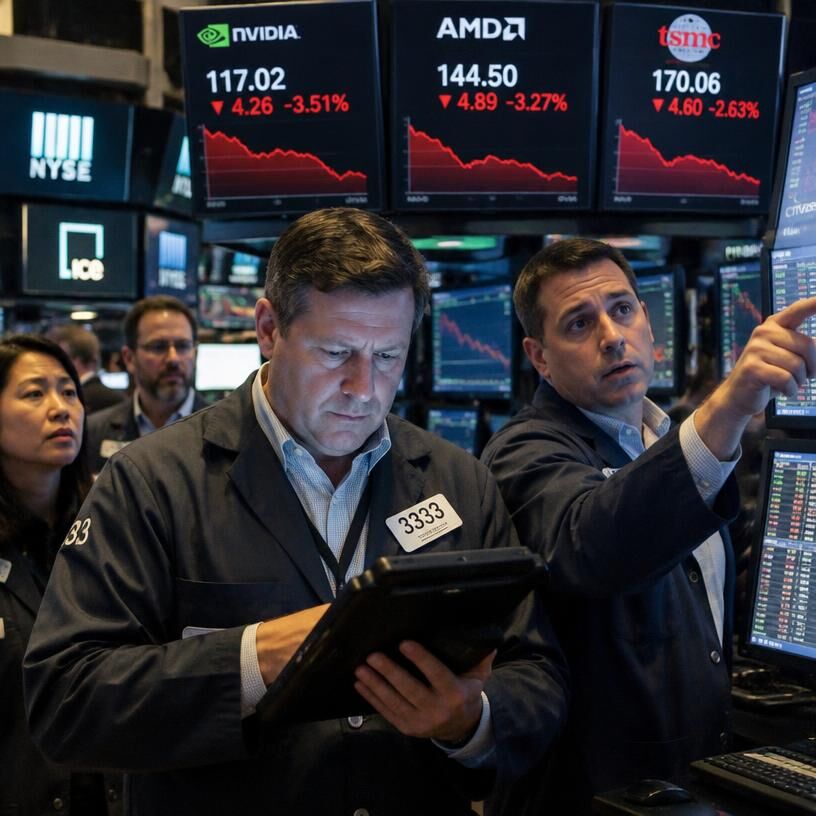
Asian stock markets face renewed volatility as South Korea, China and Taiwan introduce emergency measures to stabilize shares amid global AI investment concerns.
Focus Keyphrase: Asian stock markets
Secondary Keywords: KOSPI, Taiwan stock market, CSI 300, China stock market, artificial intelligence stocks, AI investment, semiconductor stocks, Asian financial markets, global stock market volatility.
📉 Asian Stock Markets Face Renewed Pressure as AI Investment Concerns Spread
Asian financial markets are experiencing another period of significant volatility as investors reassess the outlook for artificial intelligence (AI) companies, semiconductor manufacturers and technology-related investments.
On November 23, 2026, stock markets across the region remained under pressure following a substantial technology-led sell-off on Wall Street. South Korea, Taiwan and China have become particularly important areas of concern because their financial markets are closely connected to the global semiconductor industry and the expansion of artificial intelligence infrastructure.
The downturn has prompted authorities in several major Asian economies to introduce measures designed to stabilize financial markets, discourage excessive speculation and restore investor confidence.
South Korea is preparing to activate a stock market stabilization fund, Taiwan has expanded restrictions on short selling, and China is reducing margin requirements to encourage additional investment in equities.
These developments highlight a growing concern among policymakers: the possibility that a correction in highly valued AI-related companies could spread beyond technology stocks and affect broader financial markets.
🇰🇷 South Korea Prepares Stock Market Stabilization Fund
South Korea has emerged as one of the most closely watched markets during the latest technology-sector downturn.
The country's benchmark KOSPI index experienced substantial losses as investors reduced exposure to semiconductor manufacturers and other companies associated with the artificial intelligence boom.
Major technology companies, including Samsung Electronics and SK Hynix, have benefited considerably from rising global demand for advanced chips, memory products and AI-related infrastructure.
However, the same concentration in technology stocks has increased the Korean market's vulnerability to changes in investor sentiment.
On Sunday, November 22, South Korean financial authorities announced preparations to make the country's securities-market stabilization fund available for immediate activation.
The government is reportedly preparing a fund worth approximately 10 trillion Korean won, although analysts have questioned whether this amount would be sufficient to reverse negative market sentiment.
The intervention reflects the importance of maintaining confidence in South Korea's financial system, particularly because semiconductor exports represent a major component of the country's economic performance.
A prolonged decline in technology shares could also affect household investment portfolios, corporate financing conditions and broader economic confidence.
For Seoul, the challenge is to prevent excessive market volatility without creating the impression that the government will guarantee stock prices.
🇹🇼 Taiwan Expands Restrictions to Support Its Stock Market
Taiwan is also attempting to contain the consequences of the global technology sell-off.
The island's stock market has substantial exposure to the semiconductor industry, with Taiwan Semiconductor Manufacturing Company (TSMC) occupying a central position in the global technology supply chain.
TSMC is particularly important because it manufactures advanced processors used in artificial intelligence systems, smartphones, computers and other electronic devices.
However, the concentration of technology companies within Taiwan's equity market has made it especially sensitive to changes in expectations surrounding AI investment.
Following a significant decline in its benchmark Taiex index, Taiwan's Financial Supervisory Commission announced expanded restrictions on short selling.
Under the new measures, short selling below the previous trading day's closing price is prohibited.
Authorities have also indicated that they have been purchasing shares to help stabilize the market.
Additionally, Taiwan is encouraging publicly listed companies to consider share buybacks. Companies completing eligible purchases between the fourth quarter of 2026 and the first quarter of 2027 could receive recognition through environmental, social and governance (ESG) assessments.
The strategy is intended to encourage corporate participation in supporting market confidence.
Nevertheless, Taiwan's longer-term stock market outlook will continue to depend heavily on global semiconductor demand, international technology investment and the financial performance of major chip manufacturers.
🇨🇳 China Reduces Stock Market Margin Requirements
China is taking a different approach to supporting its financial markets.
Instead of primarily restricting speculative trading, Beijing is introducing measures designed to make it easier for investors to purchase shares using borrowed funds.
The Shanghai, Shenzhen and Beijing stock exchanges announced that the minimum margin requirement for margin-financed stock purchases will fall from 100% to 80%, effective November 30, 2026.
This change will allow eligible investors to use greater leverage when purchasing securities.
According to reporting cited by Chinese state media, the adjustment could potentially release approximately $60 billion in additional funds for stock market investment.
The decision comes as China's equity markets face pressure from weakening technology sentiment and concerns about the sustainability of global AI-related valuations.
The CSI 300 index, which tracks major companies listed in Shanghai and Shenzhen, has experienced considerable weakness.
Chinese exchanges have also announced reductions in certain transaction fees, while Shenzhen is proposing a market-making mechanism for its ChiNext board.
These measures are intended to improve liquidity, encourage trading activity and strengthen investor participation.
However, encouraging leveraged investment also introduces risks.
Borrowing to purchase shares can amplify gains when markets rise, but it can also magnify losses during periods of declining valuations.
Consequently, China's approach could support short-term liquidity while potentially increasing financial risks if market confidence deteriorates further.
🤖 Why Artificial Intelligence Is Creating Financial Market Uncertainty
The latest market turbulence reflects a broader reassessment of the economic and financial implications of the artificial intelligence boom.
Over the past several years, investors have directed enormous amounts of capital toward semiconductor manufacturers, cloud computing companies, data center operators and businesses developing advanced AI technologies.
Companies across the technology industry have announced substantial investment plans to expand computing capacity and meet anticipated demand for AI services.
However, investors are increasingly questioning whether future revenues and profits will justify the enormous financial commitments being made.
Building AI infrastructure requires substantial spending on:
-
Advanced semiconductor processors and memory chips.
-
Data centers and high-performance computing facilities.
-
Electricity generation and energy infrastructure.
-
Cooling systems and specialized equipment.
-
Networking technology and cloud computing capacity.
The financial sustainability of these investments has become an increasingly important issue for investors.
Companies may eventually generate significant revenue from artificial intelligence, but the timing and scale of those returns remain uncertain.
This creates a potential mismatch between investment expectations and actual financial performance.
When investors begin questioning the profitability of an entire industry, companies with high valuations can experience substantial corrections, even if their underlying businesses remain operationally strong.
The consequences can extend beyond Silicon Valley and Wall Street.
South Korea and Taiwan are particularly exposed because semiconductor manufacturing is central to their economies and stock markets.
China also faces challenges because its technology companies operate within a complex environment shaped by domestic economic conditions, international competition and geopolitical restrictions.
🌏 Why Asian Financial Markets Matter to the Global Economy
The developments in Asia are important because the region occupies a central position in global technology manufacturing and international trade.
South Korea is a major producer of memory semiconductors and electronic components.
Taiwan plays an essential role in advanced semiconductor manufacturing through TSMC and its broader technology ecosystem.
China remains one of the world's largest manufacturing and technology markets, with extensive domestic supply chains and significant influence over global industrial production.
A prolonged stock market downturn could therefore have consequences extending beyond financial investors.
First, falling equity valuations can make it more expensive for companies to raise capital.
Second, weaker investor confidence can encourage businesses to postpone expansion plans and reduce discretionary spending.
Third, declining household wealth can affect consumer confidence, particularly in economies where retail investors have significant exposure to equities.
Finally, financial market volatility can influence international investment decisions and currency movements.
The semiconductor industry is especially important because its products support industries ranging from automobiles and telecommunications to cloud computing, defense technology and consumer electronics.
Any sustained reduction in investment across this sector could eventually influence manufacturing activity and international supply chains.
🇺🇸 Wall Street's Influence on Asian Markets
The latest Asian sell-off also demonstrates how closely regional financial markets remain connected to developments in the United States.
Wall Street's technology-heavy indices have been particularly sensitive to concerns about AI valuations, semiconductor demand and the enormous spending commitments associated with data center construction.
The S&P 500 entered correction territory following its recent losses, while the Nasdaq experienced particularly significant pressure.
However, US equity futures rebounded during Asian trading on Monday, November 23, suggesting that some investors were looking for opportunities following the recent declines.
The recovery in futures did not immediately translate into broad confidence across Asian markets.
This distinction is important.
A rebound in US futures can indicate short-term buying interest, but it does not necessarily mean that investors have resolved their concerns about technology valuations or the profitability of AI infrastructure.
Markets will continue to monitor corporate earnings, semiconductor demand, financing conditions and the financial commitments of major technology companies.
⚠️ Can Government Intervention Prevent a Deeper Market Correction?
The coordinated response from South Korea, Taiwan and China demonstrates that Asian authorities are increasingly concerned about financial market stability.
However, government intervention has limitations.
Stock stabilization funds, restrictions on short selling and adjustments to margin requirements can influence trading activity and potentially reduce short-term volatility.
They cannot guarantee that stock prices will recover or that investors will regain confidence.
Ultimately, sustainable market performance depends on corporate earnings, economic growth, investment returns and the availability of capital.
There are also differences between the strategies being adopted.
South Korea and Taiwan are attempting to limit some forms of downward trading pressure and encourage institutional or corporate participation.
China is seeking to improve liquidity by allowing investors to use greater leverage.
Each approach carries different financial implications.
If investors remain concerned about the profitability of AI infrastructure, additional liquidity alone may not be sufficient to reverse the market downturn.
🔎 What Investors Should Watch Next
Several developments could determine the direction of Asian financial markets during the coming weeks.
1. Semiconductor company earnings
Financial results from major chip manufacturers will provide important information about whether demand for AI processors and memory products remains strong.
2. AI infrastructure investment
Investors will closely examine spending commitments from major technology companies, particularly whether data center investments can generate sufficient long-term returns.
3. Government stabilization measures
The effectiveness of South Korea's proposed stabilization fund, Taiwan's restrictions and China's margin requirement changes will be important indicators of market confidence.
4. US monetary policy
Interest rate expectations will influence borrowing costs, equity valuations and international capital flows. Higher financing costs could create additional pressure for technology companies with substantial investment requirements.
5. Global geopolitical developments
International trade tensions, semiconductor export restrictions and geopolitical uncertainty could influence investment decisions and technology supply chains.
Conclusion: Asia's AI Investment Boom Faces an Important Financial Test
The latest volatility in Asian stock markets represents more than a temporary decline in technology shares.
It reflects a broader reassessment of the relationship between artificial intelligence investment, corporate profitability and financial market valuations.
South Korea, Taiwan and China are responding with different policy measures, demonstrating the importance their governments place on maintaining confidence in their respective financial systems.
Nevertheless, the long-term outlook will depend on whether the artificial intelligence industry can translate its enormous infrastructure investments into sustainable economic returns.
The global AI revolution remains an important source of potential productivity growth, technological innovation and business opportunities. However, the financial markets supporting this transformation will not necessarily move in a straight line.
For international investors, the latest developments offer an important reminder: technological progress and attractive investment valuations are not always the same thing.
The coming weeks could provide a clearer indication of whether the current downturn represents a temporary correction in an expanding industry or the beginning of a more substantial reassessment of global technology investments.
Financial Disclaimer: This article is for informational and educational purposes only. It does not constitute financial, investment or trading advice. Stock markets involve risks, and investors should conduct independent research or consult qualified financial professionals before making investment decisions.




0 Comments