
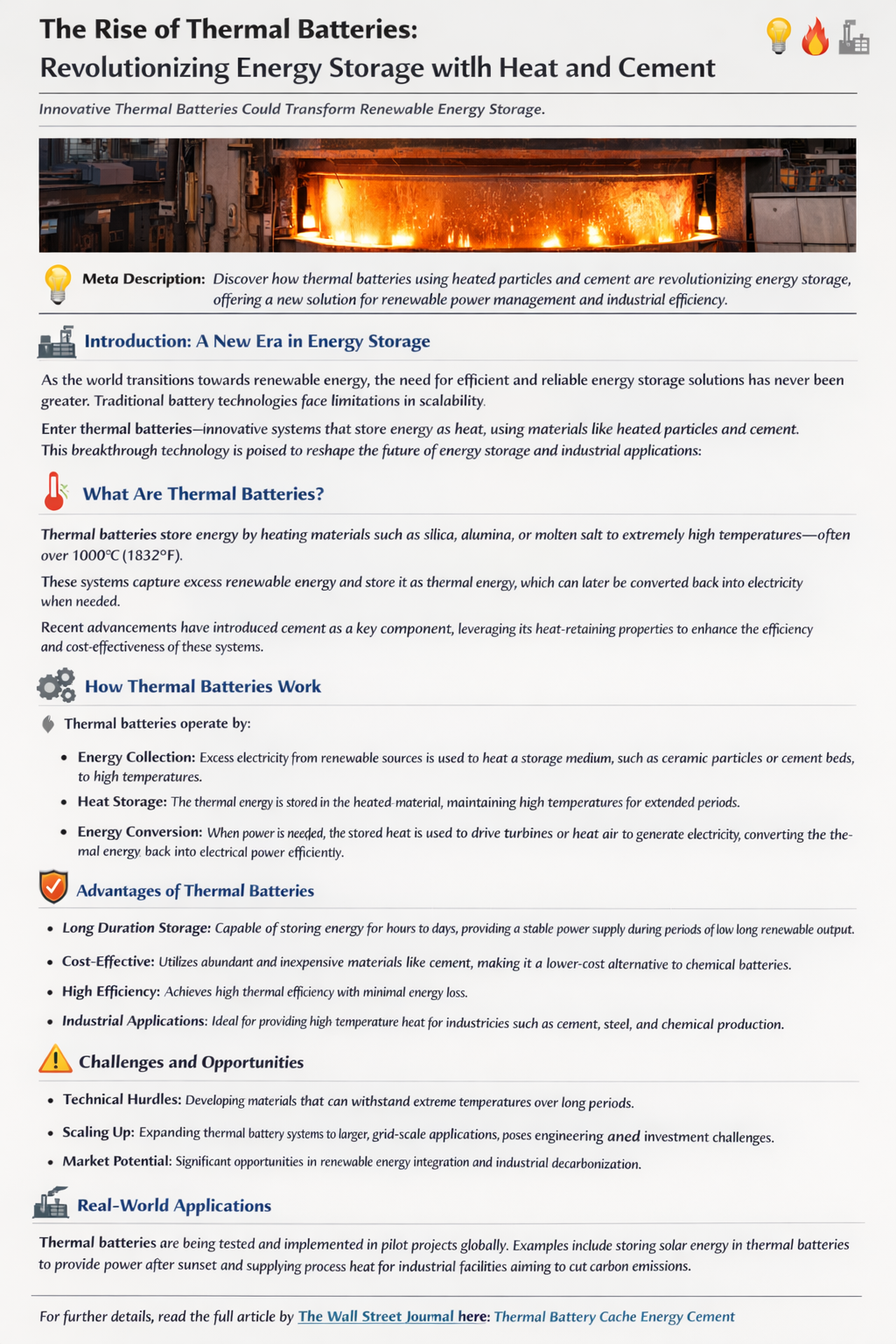
Explore Cache Energy’s innovative cement-based thermal battery, a professional and technical analysis of its chemistry, engineering, and potential to transform renewable energy storage in industrial applications.
🔋 Introduction: The Industrial Energy Storage Challenge
The global energy landscape is undergoing a paradigm shift, driven by the urgent need to decarbonize industrial operations and integrate intermittent renewable sources such as wind and solar. Traditional chemical batteries, while effective for electricity storage, face technical and economic limitations when applied to high-temperature, high-capacity industrial environments.
Thermal energy storage (TES) presents a compelling alternative, particularly in the form of cement-based thermal batteries pioneered by Cache Energy. By storing energy in chemical bonds as heat rather than electrons, these systems promise to overcome critical barriers associated with scalability, cost, and longevity.
This article provides a professional and technical analysis of Cache Energy’s cement thermal battery, exploring its materials science, chemical mechanisms, system engineering, and industrial applications, with implications for grid integration, decarbonization, and sustainable energy storage.
🧱 Thermal Battery Fundamentals
Thermal batteries store energy as heat, converting electrical energy into thermal potential and then releasing it as required. The core principles include:
- High-temperature storage: Thermal batteries can operate at temperatures exceeding 500°C, far beyond conventional lithium-ion chemistry.
- Chemical energy conversion: Storage occurs via reversible chemical reactions, enabling long-term energy retention without self-discharge.
- Scalable materials: The use of inexpensive and abundant materials, such as calcium oxide (CaO) and cement-based composites, reduces costs compared to rare-metal batteries.
In industrial contexts, TES is particularly advantageous because heat is often the primary energy demand. Applications include:
- Process heat in steel, cement, and chemical plants
- District heating networks
- Industrial drying and sterilization
Cache Energy’s innovation lies in converting cement chemistry into a repeatable, industrial-scale energy storage system, leveraging the reversible hydration reaction of calcium oxide to capture and release energy efficiently.
⚙️ Chemical Mechanism: The Core Reaction
Cache Energy’s thermal battery relies on the well-known exothermic reaction between quicklime (CaO) and water to release heat:
Charging the battery involves the reverse reaction:
- Charging: Electricity heats the material to approximately 500–600°C, driving off water and forming quicklime.
- Storage: The dehydrated pellets retain stored chemical energy indefinitely, provided they remain dry.
- Discharging: Rehydration triggers the exothermic reaction, releasing heat suitable for industrial processes.
The energy density of this system is significant: approximately 500–700 kJ per kg of CaO, which is competitive with other thermal storage media while remaining cost-effective and environmentally benign.
🏭 Pellet Design and System Engineering
The performance of Cache Energy’s thermal battery hinges on pelletized cement materials designed for repeated thermal cycling. Key design considerations include:
- Particle geometry: Spherical or cylindrical pellets enhance heat transfer efficiency and minimize thermal stress.
- Mechanical integrity: Pellets must withstand repeated expansion and contraction without fracture.
- Thermal conductivity: Optimized composites ensure rapid charging and discharging cycles.
System architecture consists of:
- Charging reactor: Where electricity heats pellets to drive dehydration.
- Storage silos: Large-capacity containers that protect pellets from moisture ingress.
- Discharge unit: Rehydration occurs in a controlled reactor, releasing heat to industrial systems or district heating grids.
Engineering challenges such as reactor insulation, pellet handling, and thermal expansion have been addressed through materials science innovation and modular design.
🌍 Industrial Applications
The primary industrial advantage of cement-based thermal batteries lies in their ability to provide high-temperature heat directly, without conversion back to electricity. Key sectors include:
- Cement and steel production: These industries require continuous heat at temperatures exceeding 500°C, making thermal batteries ideal for reducing fossil fuel consumption.
- Chemical processing: Processes such as drying, calcination, and chemical synthesis benefit from stored heat.
- District heating: Thermal batteries can provide stable heat to residential and commercial zones, especially when paired with renewable electricity.
By integrating TES into existing industrial processes, companies can reduce CO₂ emissions, stabilize energy costs, and increase renewable energy utilization.
🔬 Technical Validation and Pilot Programs
Cache Energy has undertaken real-world pilot projects to validate the technology’s performance. Highlights include:
- Industrial-scale test reactors: Demonstrated >95% reaction efficiency over multiple cycles.
- Thermal endurance testing: Pellets sustained >1,000 cycles with minimal degradation.
- Renewable integration studies: Wind and solar excess power effectively charged the system, demonstrating grid compatibility.
These pilots confirm that the technology is not just theoretical but ready for deployment at industrial scales.
💡 Energy Efficiency and Economic Analysis
Thermal batteries offer distinct energy and cost advantages:
- Efficiency: Round-trip efficiency (electricity → heat → electricity/heat usage) can exceed 85% for industrial applications where heat is the end product.
- Cost per kWh stored: Estimated to be significantly lower than lithium-ion when factoring in long lifespan and abundant raw materials.
- Scalability: Silos and reactors can be sized from megawatt-hours to gigawatt-hours.
Economic modeling indicates potential payback periods of 3–6 years for industrial adopters, making this a financially viable decarbonization strategy.
🔗 Challenges and Engineering Considerations
Despite its advantages, widespread adoption of cement thermal batteries faces several technical and operational challenges:
- Material durability: Ensuring pellets remain structurally sound after thousands of thermal cycles.
- Rehydration control: Precise water dosing is required to avoid uncontrolled exothermic reactions.
- Integration with existing systems: Retrofitting industrial plants requires careful thermal management planning.
Ongoing research focuses on enhanced pellet composites, automated handling, and hybrid system integration to overcome these hurdles.
📈 Market and Strategic Outlook
The industrial energy storage market is expanding rapidly, driven by:
- Renewable energy adoption
- Global decarbonization mandates
- Rising industrial energy costs
Cement-based thermal batteries occupy a niche with high growth potential. Unlike conventional electrochemical batteries, they address high-temperature, high-capacity needs that are currently unmet.
Potential future developments include:
- Integration with smart grids: Automated charging/discharging based on renewable generation and demand.
- Hybrid systems: Combining TES with lithium-ion or hydrogen storage for versatile energy management.
- Global deployment: Particularly in regions with abundant renewable resources and high industrial heat demand.
🏁 Conclusion: A Professional Assessment
Cache Energy’s cement-based thermal battery represents a technical breakthrough in industrial energy storage. By harnessing reversible chemical reactions in a scalable, durable, and cost-effective manner, this system addresses critical gaps in high-temperature renewable storage.
For engineers, energy analysts, and industrial operators, the technology offers:
- High reliability and durability
- Scalable heat storage solutions
- Reduced reliance on fossil fuels and lower operational emissions
With continued development, pilot validation, and integration with renewable energy sources, cement-based thermal batteries could redefine industrial energy storage and contribute significantly to global decarbonization goals.
Source: Wall Street Journal – Thermal Battery: Cache Energy’s Cement Solution




0 Comments