
Europe’s Rare-Earth Challenge: Can the New Estonian Plant Break China’s Grip?
Introduction
Europe is stepping into a critical strategic arena: rare-earth elements. These minerals are essential for modern technology, from electric vehicles and wind turbines to robotics and defense systems. The continent’s heavy reliance on China for rare-earth supply has long been a strategic vulnerability. A new rare-earth magnet plant in Narva, Estonia, backed by European initiatives and private investment, promises to be a milestone. Yet experts caution that breaking China’s dominance will be far more difficult than opening a single factory.
Why Rare-Earth Elements Are Crucial
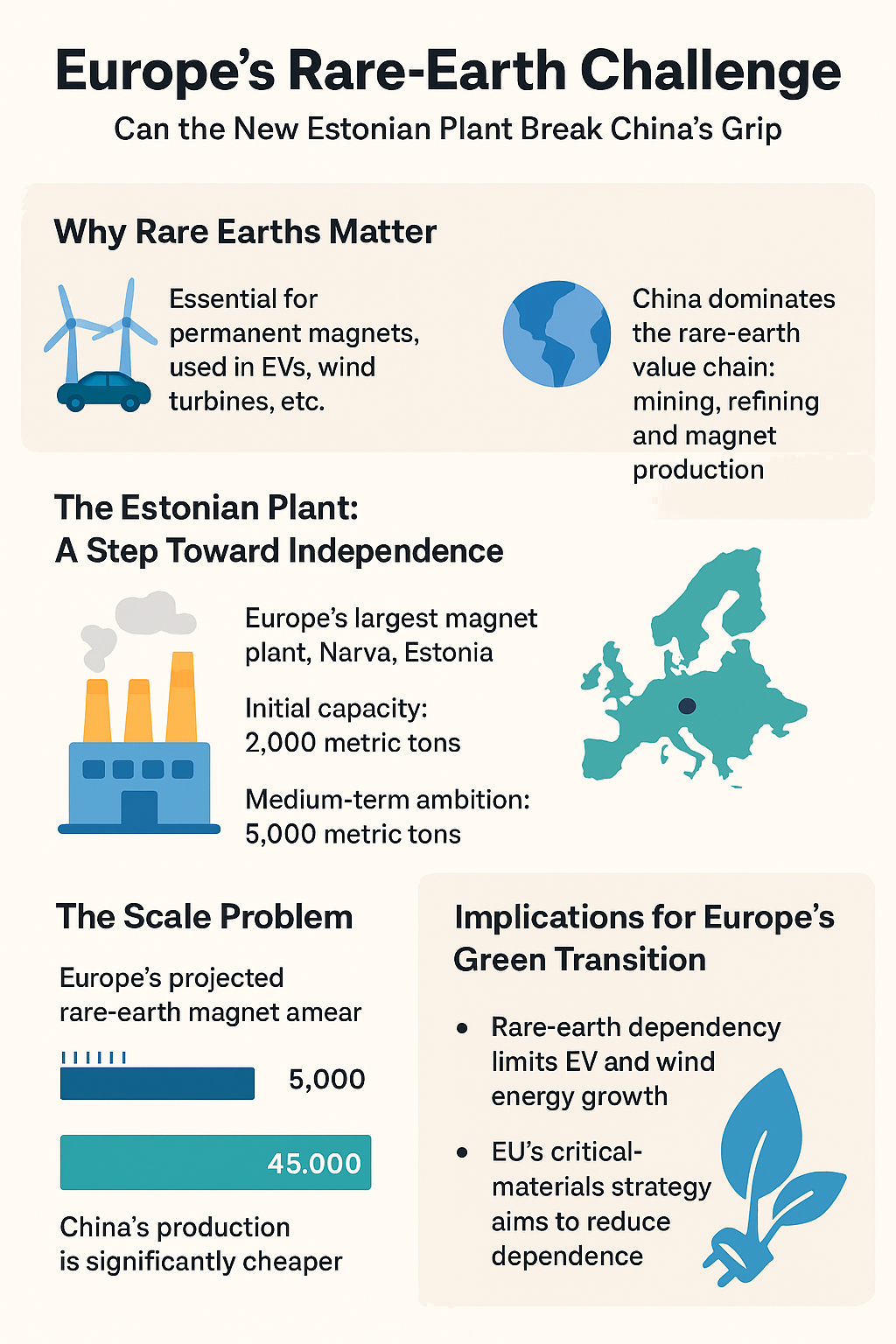
Rare-earth elements (REEs) are a group of 17 metallic elements used to produce high-performance magnets, essential components for clean energy technologies and high-tech defense systems. Without these magnets, the production of electric vehicles, wind turbines, and advanced electronics would face severe constraints.
China controls the majority of the global rare-earth supply chain, from mining and refining to magnet manufacturing. This gives the country enormous geopolitical leverage and creates a supply risk for Europe, especially as the demand for clean energy and electric mobility grows.
The Estonian Plant: A Step Toward Independence
The Narva facility, currently Europe’s largest rare-earth magnet plant, represents a bold first step toward localizing critical production. Its initial capacity is set at 2,000 metric tons of permanent magnet material, with medium-term plans to expand toward 5,000 tons.
Major European manufacturers, particularly in the automotive sector, are already eyeing the plant as a strategic supplier. The facility benefits from streamlined permitting and strong local support, reflecting a broader push across Europe to reduce dependence on foreign supply chains.
Beyond its practical contribution, the plant carries symbolic weight. It represents Europe’s commitment to securing technological and industrial sovereignty in an era where rare-earth dependency could limit economic and defense ambitions.
The Scale Problem
Despite its significance, the Narva plant’s output remains modest compared to projected European demand, which could reach 45,000 tons by 2030. Even with expansion, the plant alone cannot secure Europe’s independence from China.
Cost challenges add another layer of complexity. Producing rare-earth magnets in Europe is more expensive than in China, making economic competitiveness a central issue. While some manufacturers are willing to pay a premium for regional supply, scaling production without substantial public support could remain prohibitively expensive.
Geopolitical and Strategic Risks
China continues to control the global rare-earth market through licensing and export restrictions. Even as Europe invests in domestic production, it remains exposed to potential supply disruptions.
The EU is pursuing broader strategic measures, including stockpiling, joint purchasing agreements, and recycling initiatives, to reduce dependence. However, these efforts are still in early stages, leaving industries, particularly automotive and defense, cautious about supply security.
The Narva plant is only the beginning. Europe’s rare-earth strategy must be holistic, combining production, recycling, and strategic policy initiatives to mitigate risk and secure long-term technological independence.
Implications for Europe’s Green Transition
Rare-earth dependency extends beyond industry into Europe’s climate and energy ambitions. Electric vehicles and renewable energy technologies require a reliable supply of these elements. Any disruption could slow the continent’s transition toward net-zero emissions.
The plant highlights the importance of the EU’s critical-materials strategy, aiming to support scaling, innovation, and regional supply chain resilience. Without significant investment and coordinated policies, Europe risks falling behind in both clean energy deployment and technological sovereignty.
Conclusion
The new Estonian plant is a landmark achievement and a symbol of Europe’s determination to secure its rare-earth supply chain. Yet, in scale and strategic impact, it represents a first step rather than a complete solution. Breaking China’s grip on rare-earth production will require sustained investment, expanded capacity, and comprehensive European policies.
Europe’s rare-earth challenge exemplifies the broader geopolitical tension between technological independence and global supply dependencies. Success will depend on the continent’s ability to combine industry, policy, and innovation into a resilient, forward-looking strategy.
Discussion Prompt for Engagement:
Can Europe realistically scale its rare-earth independence without heavy subsidies and coordinated industrial policy? Share your thoughts in the comments below.
-
Primary keywords: Europe rare-earth, rare-earth supply chain, China dependence, electric vehicle magnets, green energy transition
-
Secondary keywords: EU critical materials, rare-earth plant Estonia, clean energy technology, high-tech magnets
Source: WSJ



0 Comments