
🇨🇳 How a Chinese AI Firm Bypassed U.S. Export Rules to Access Nvidia’s Most Advanced Chips
The Global AI Arms Race Exposes the Limits of Technology Controls
Introduction: The New Frontline of the AI War
In the ever-intensifying U.S.–China tech rivalry, artificial intelligence has become the ultimate battlefield.
A recent Wall Street Journal investigation uncovered how a Chinese AI startup managed to gain access to Nvidia’s most advanced AI chips—despite strict U.S. export bans designed to keep such technology out of China’s hands.
The discovery exposes the fragile boundaries of global technology controls, showing how cloud networks, foreign intermediaries, and cross-border corporate ownership can undermine even the tightest trade restrictions.
The Story Behind the Loophole
According to The Wall Street Journal, the case revolves around INF Tech, a Shanghai-based AI startup that develops applications for finance and healthcare.
Although U.S. law prohibits Nvidia from selling its most advanced chips directly to China, INF Tech never physically imported the hardware. Instead, it accessed the chips remotely through international data centers.
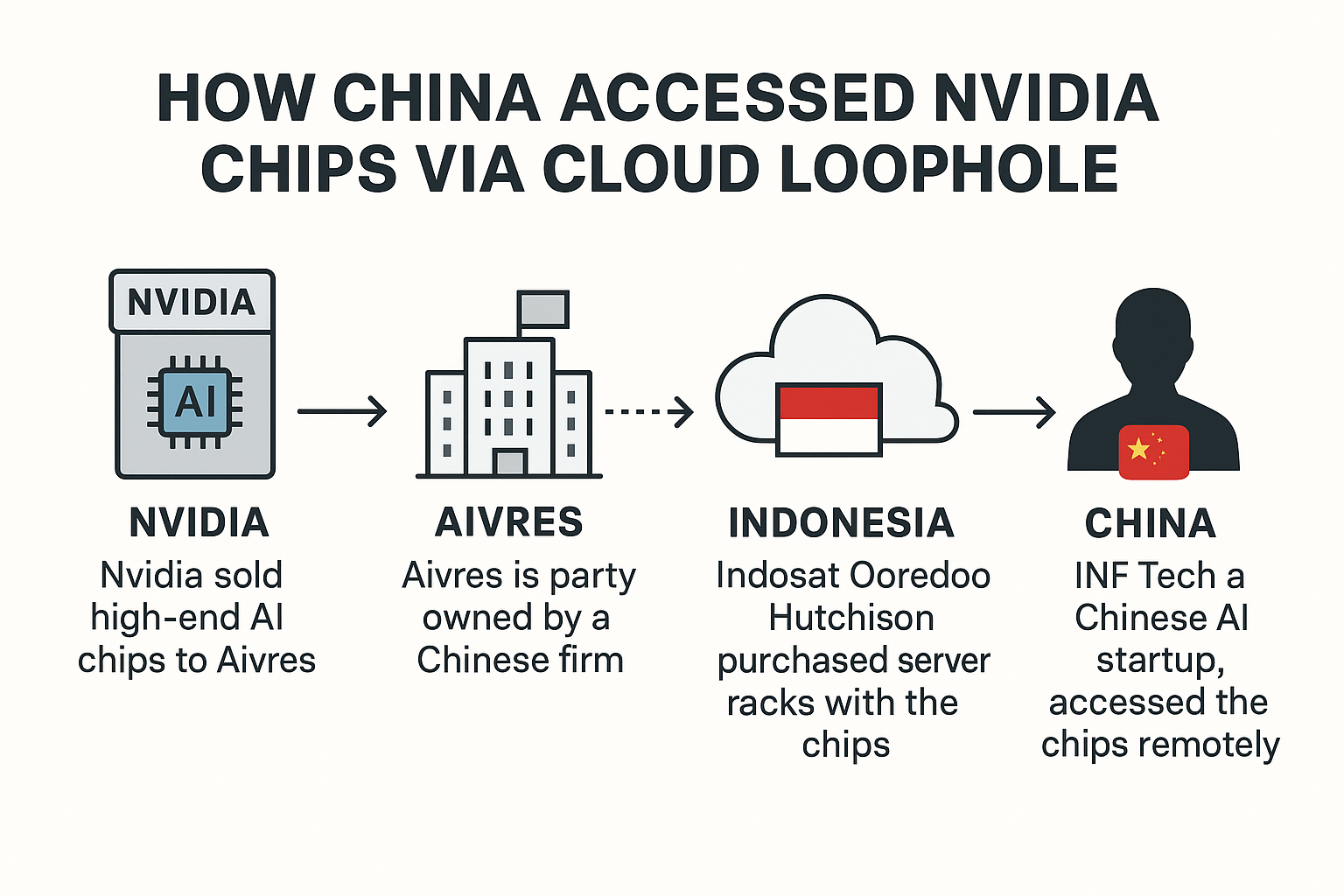
Here’s how the system reportedly worked:
-
Nvidia sold its high-end AI chips—known as “Blackwell” processors—to Aivres, a U.S. company partly owned by a Chinese firm that is already on Washington’s trade watchlist.
-
Aivres sold the chips to Indosat Ooredoo Hutchison, a telecom operator in Indonesia that hosts the physical servers.
-
INF Tech then rented computing power from those Indonesian servers, effectively gaining access to Nvidia’s technology without ever violating the letter of U.S. export laws.
While this arrangement appears legal on paper, it clearly undermines the spirit of Washington’s export-control strategy—which aims to limit China’s ability to train large-scale AI models using American hardware.
Why the Loophole Matters
1. The Limits of Export Control Enforcement
U.S. export laws focus on where the physical chip resides—not on who controls or uses it remotely.
That creates an enormous loophole in the cloud era. As long as the chips remain physically outside China, companies can still provide remote access to Chinese clients with little oversight.
2. The AI Arms Race: Hardware Is Power
Nvidia’s cutting-edge chips, such as the H100, H200, and Blackwell series, are the engines behind today’s AI revolution.
They enable faster model training, more efficient data processing, and competitive advantages in industries from defense to pharmaceuticals.
In effect, whoever controls the hardware controls the future of AI innovation—and, by extension, national power.
3. Globalization’s Double-Edged Sword
This case demonstrates how global supply chains can blur national boundaries.
A chip made in the U.S., sold via a partner in Indonesia, and operated by a Chinese company illustrates how technology globalization makes enforcement nearly impossible.
It raises the question: Can export controls truly work in a cloud-based world?
The Major Players
| Company | Role in the Network | Key Details |
|---|---|---|
| Nvidia Corporation (U.S.) | AI chip designer | Supplies world-leading GPUs, limited in China by U.S. rules. |
| Aivres (U.S. subsidiary) | Middleman distributor | Partially owned by a Chinese firm on the U.S. entity list. |
| Indosat Ooredoo Hutchison (Indonesia) | Cloud infrastructure host | Purchased server racks containing Nvidia chips. |
| INF Tech (China) | AI startup | Accessed computing power remotely to train models for finance and healthcare. |
Economic and Security Implications
For the U.S.
Washington now faces a strategic dilemma:
-
Tighten export controls further—risking backlash from U.S. companies that rely on global sales.
-
Or accept some degree of technological leakage, focusing instead on maintaining innovation leadership.
For China
This workaround shows China’s determination to continue AI research despite restrictions.
It also emphasizes the nation’s growing sophistication in navigating international technology rules, leveraging offshore partnerships and remote access architectures.
For Nvidia and Global Business
While Nvidia must comply with export bans, it still benefits indirectly when foreign data centers host its hardware.
This setup sustains demand for its GPUs while giving the company plausible deniability regarding end-users in restricted markets.
Global AI Policy at a Crossroads
Experts warn that the AI hardware gap could influence everything from economic competitiveness to national defense.
The ability to train large AI models determines which nations will lead in:
-
Advanced robotics
-
Cyber defense
-
Scientific research
-
Predictive healthcare
Without stronger international agreements on cloud access and AI compute governance, the U.S. may find itself constantly chasing new loopholes.
Some analysts suggest creating global licensing systems for AI compute, ensuring transparency about who uses high-end chips—even when hosted abroad.
Conclusion: Redrawing the Map of Technological Power
The story of INF Tech and Nvidia’s chips isn’t just about one clever workaround—it’s a warning shot for the global tech ecosystem.
In a world where data flows faster than diplomacy, and where computing power can be rented from anywhere, national boundaries may no longer define access to technology.
As nations race to regulate AI, this case illustrates that the future of innovation will belong to those who adapt fastest—not just those who control the hardware, but those who control the rules.
Sources: WSJ




0 Comments