
Government Shutdown Delays Jobs Report: Economic Implications and Market Reactions
1. Introduction: A Rare Data Blackout
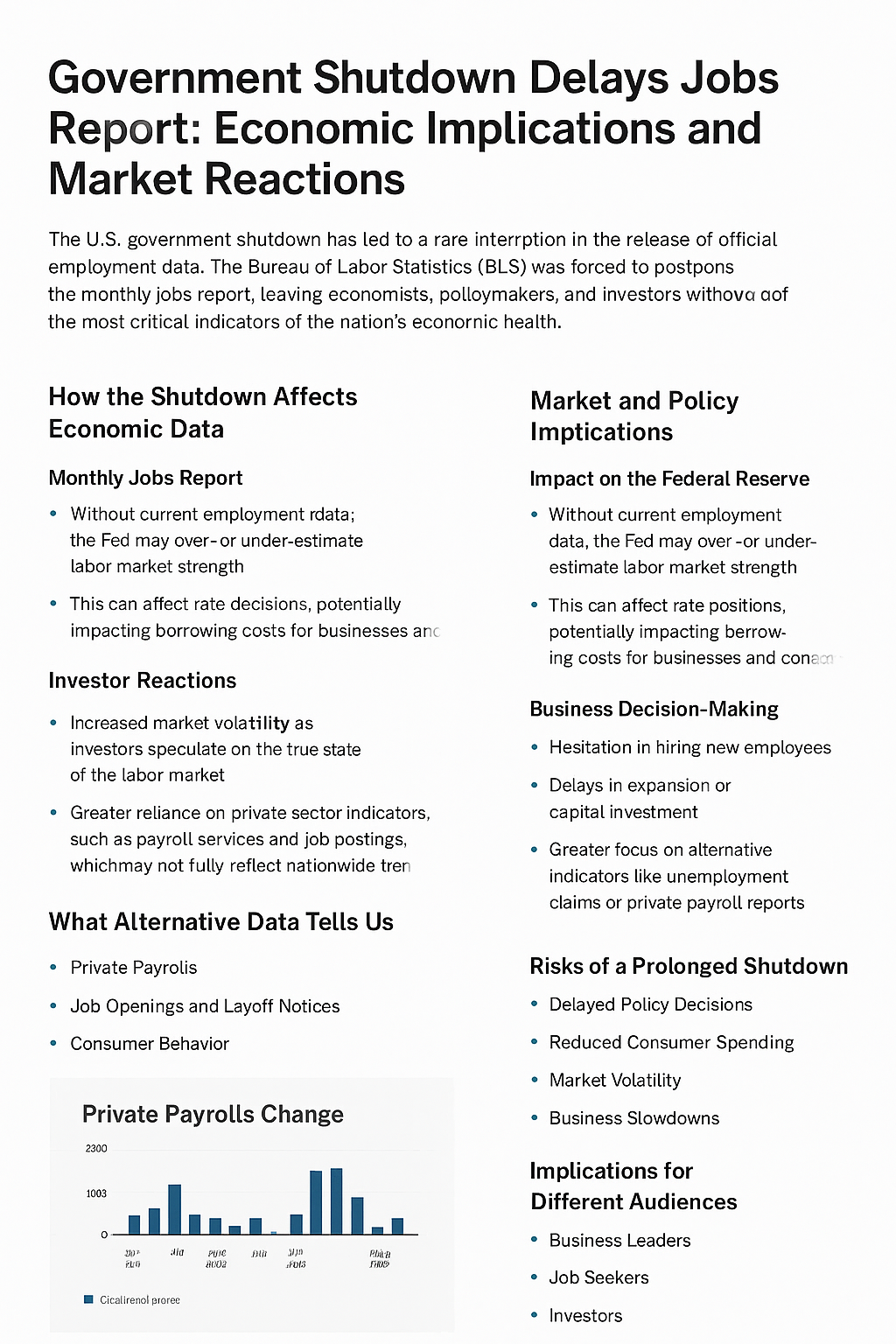
The ongoing U.S. federal government shutdown has led to a rare interruption in the release of official employment data. The Bureau of Labor Statistics (BLS) was forced to postpone the monthly jobs report, leaving economists, policymakers, and investors without one of the most critical indicators of the nation’s economic health.
This unprecedented delay raises important questions: How is the labor market really performing? What does this mean for monetary policy? And how might businesses and consumers respond in the absence of key data?
2. How the Shutdown Affects Economic Data
The federal government shutdown impacts not just employment reporting but also several other critical economic indicators:
-
Monthly Jobs Report: Delayed publication creates uncertainty in evaluating hiring trends, wage growth, and unemployment.
-
Inflation and Consumer Spending: Missing data makes it harder for the Federal Reserve to gauge economic momentum and adjust interest rates accordingly.
-
GDP Forecasts: Business investment decisions are affected when key data points are missing, potentially slowing economic growth.
Even temporary gaps in reporting can ripple through financial markets, influencing investment decisions and consumer confidence.
3. Market and Policy Implications
3.1 Impact on the Federal Reserve
The Federal Reserve relies heavily on monthly employment data to make informed decisions about interest rates. A delay introduces risk:
-
Without current employment data, the Fed may over- or under-estimate labor market strength.
-
This can affect rate decisions, potentially impacting borrowing costs for businesses and consumers.
3.2 Investor Reactions
Financial markets thrive on certainty. Missing jobs data may lead to:
-
Increased market volatility as investors speculate on the true state of the labor market.
-
Greater reliance on private-sector indicators, such as payroll services and job postings, which may not fully reflect nationwide trends.
3.3 Business Decision-Making
Companies depend on labor data to plan hiring, expansion, and compensation strategies. Delays can lead to:
-
Hesitation in hiring new employees.
-
Delays in expansion or capital investment.
-
Greater focus on alternative indicators like unemployment claims or private payroll reports.
4. What Alternative Data Tells Us
Even with the official BLS report postponed, private sources offer some insights:
-
Private Payrolls: Reports from payroll service providers can give early indications of hiring trends.
-
Job Openings and Layoff Notices: Job postings and unemployment insurance filings may hint at labor market shifts.
-
Consumer Behavior: Spending patterns can signal confidence in employment stability.
These alternative measures suggest the labor market may be slowing, though not necessarily entering a crisis.
5. Risks of a Prolonged Shutdown
A longer government shutdown could exacerbate economic uncertainty:
-
Delayed Policy Decisions: Interest rate adjustments or stimulus measures may be postponed.
-
Reduced Consumer Spending: Furloughed employees may cut back on discretionary purchases.
-
Market Volatility: Investors may become more cautious amid missing data and policy uncertainty.
-
Business Slowdowns: Companies may postpone hiring or investment, further impacting growth.
6. What to Watch in the Coming Weeks
Key indicators to monitor as the government reopens:
-
Release Date of the Jobs Report: Market expectations and forecasts will focus on when delayed reports are published.
-
Private Employment Data: ADP and payroll services can provide early insights.
-
Inflation Metrics: Wage and employment data tie closely to inflation trends.
-
Political Developments: Resolution of the shutdown will have immediate economic consequences.
7. Implications for Different Audiences
-
Business Leaders: Use alternative labor data to inform hiring and investment decisions.
-
Job Seekers: Prepare for potential softening in the job market; consider skill enhancement and flexible opportunities.
-
Investors: Focus on broader economic indicators beyond the delayed BLS report.
-
General Public: Stay informed and understand that missing data is a temporary, though significant, disruption.
9. Conclusion
The government shutdown has created an unusual blind spot in U.S. economic data, delaying a key jobs report and introducing uncertainty for markets, policymakers, and businesses. While alternative data offers partial insight, the full impact remains unknown until the government reopens.
For educated readers, staying informed through alternative metrics, tracking private sector trends, and understanding the broader implications can help navigate this period of uncertainty effectively.
Source: WSJ




0 Comments